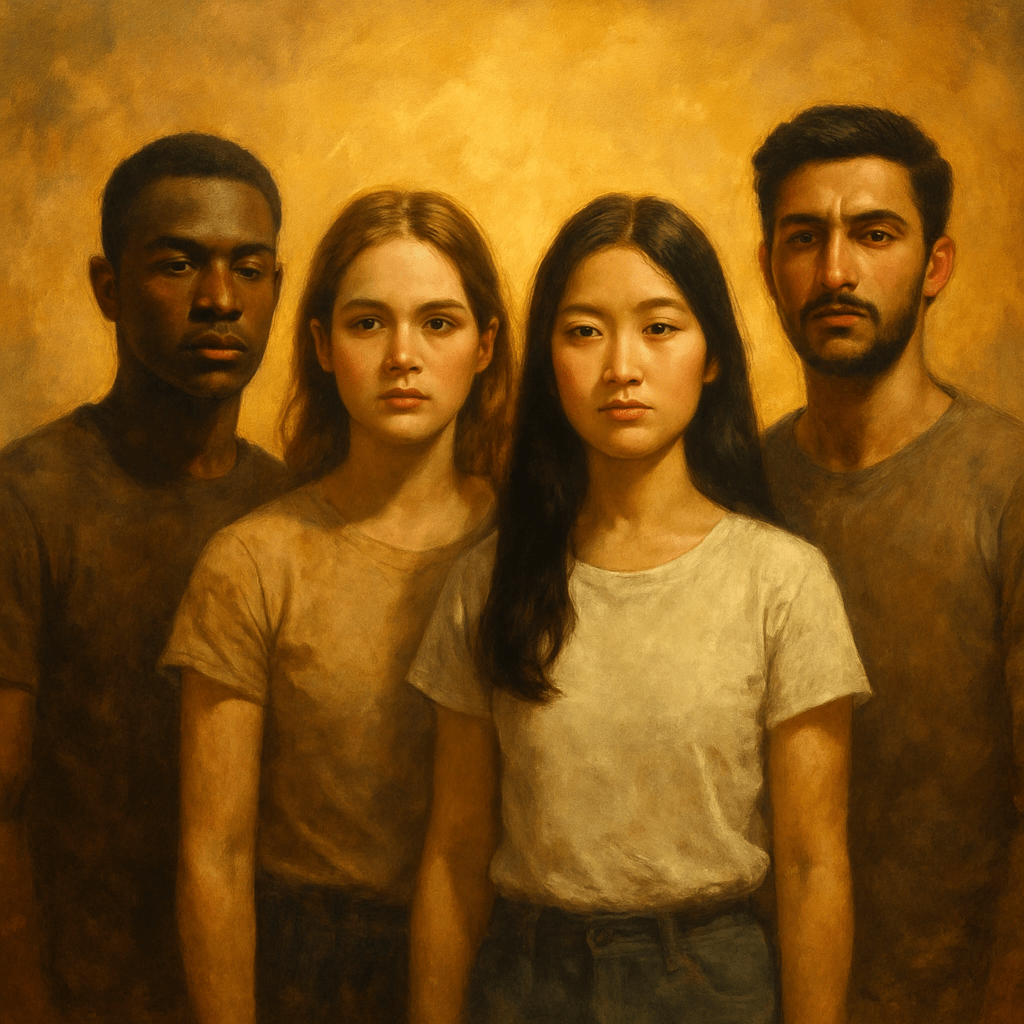
Spoken Word audio file
(Essay / Reflection – 2025)
By Jules Scott
We still call women the weaker sex. In 2025.
We still raise our girls to be careful, and our boys to be strong.
And then we act surprised when both grow up frustrated, lonely, and afraid of one another.
But I don’t want to tell girls to be careful.
I want to tell them to be strong.
I want to tell them: this world is yours — take ownership of it.
Not by shrinking. Not by apologizing.
But by knowing your strength and carrying it like a torch.
And I don’t want to lie to them either.
We live in a world that is wild, unpredictable, sometimes cruel.
A girl biking home alone is a target.
But so is a boy.
Danger does not discriminate by gender — what does is how we’ve taught them to respond.
We teach girls to fear.
We teach boys to dominate.
And then we wonder why women walk home with keys in their fists,
and why men grow into anger they don’t know how to name.
The truth is, we should be teaching them the same thing:
Responsibility.
Not as punishment. Not as obedience.
But as power.
For girls, responsibility means: your life is yours — no one has the right to take it. Own it. Defend it.
For boys, responsibility means: your strength is sacred — use it to protect, not to harm. Carry it with honor, not with cruelty.
Strength without responsibility becomes danger.
Care without courage becomes silence.
And we are raising our children into both, when what they deserve is neither.
The Double Trap
Women are told they are the weaker sex.
But here’s the cruel trick: they are forced to both fear men and serve men at the same time.
Be careful. Be quiet. Be agreeable.
Smile, even when you don’t want to.
Take the jokes, even when they cut you.
Carry the weight of men’s comfort on your back, while also carrying the fear of what happens if you don’t.
That is not weakness. That is captivity.
And men?
They are told they are the stronger sex.
But here’s their trap: they are not allowed to show weakness, not allowed to cry, not allowed to admit they don’t know how to love without control.
They are told strength means domination. That a man without power over others is no man at all.
So they grow up armored, cut off from tenderness, angry at themselves, angry at the world, hungry for something they can’t name.
That is not strength. That is prison.
We raise girls into obedience and call it care.
We raise boys into violence and call it strength.
And then we wonder why women shrink and men explode.
We wonder why our streets are unsafe, why our homes are full of silent suffering, why our children inherit the same broken inheritance we never dared to question.
This isn’t just unfair to women. It’s unfair to men too.
Because both are reduced, diminished, distorted.
Both are taught to be half-human.
The Forgotten Strength of Women (and Men)
We keep telling women their strength lies in beauty.
That their power is in a pretty face, a perfect body, a way of being admired and captured.
And so many grow up thinking their value is measured in the eyes of others — whether they can be desired, whether they can be chosen.
But beauty is not strength.
It can inspire, yes. It can attract. But on its own, it is not power.
Real strength is responsibility.
It is deeds, not lipstick.
It is building, not just being looked at.
And the same is true for men.
Their strength does not live in how much they can bench-press, or how fast they can run, or how many goals they score.
Because those things can make them admired, but admiration is not power.
Real strength is also responsibility.
It is how they use what they have — not for conquest, but for care.
But beneath all this is the deepest wound of all:
We don’t teach men or women to know who they are.
We don’t teach self-worth.
So they learn to depend on others to tell them: you are beautiful, you are strong, you are wanted.
They mistake being admired for being alive.
Breaking the cycle means teaching girls: you are not only a face, a body, a prize.
And teaching boys: you are not only muscles, trophies, and dominance.
It means giving both the tools to know themselves, so they can make choices not from emptiness, but from consciousness.
Because when you know who you are, you don’t need someone else to complete you.
You don’t need to break others to prove yourself.
You don’t need to perform strength or beauty to be worthy.
That is where freedom begins.
That is where the cycle breaks.
The Frustration Nobody Names
This system breeds frustration like a factory.
Men are raised to think strength means control.
So when life demands tenderness, they don’t know what to do with it.
When love asks for equality, they don’t recognize it.
When they feel small, lost, or afraid, they cover it with rage.
And deep down, many are terrified — terrified that without domination, they are nothing.
Women are raised to think love means service.
So when they want freedom, they feel guilty.
When they say no, they fear they will be punished.
When they speak truth, they are told they are too loud, too emotional, too much.
And deep down, many are exhausted — exhausted from being everything to everyone and never fully themselves.
And here’s the tragedy: both sides are lonely.
Men cut off from their own softness.
Women cut off from their own strength.
Everyone waiting for the other to give them what the system already stole.
That is the frustration nobody names.
It’s not men versus women.
It’s a world that keeps us all half-alive,
and then tells us that is normal.
The Media & Politics Connection
And then a tragedy happens.
A girl is killed on her way home.
Her name fills headlines, her picture floods timelines, her death becomes the latest fuel for outrage.
For a week, the country screams.
Politicians rush to microphones, each with their own angle.
One blames asylum policy.
Another blames unsafe streets.
The media feasts, panel after panel, column after column.
We eat it like the best cake.
We gorge on the details, the grief, the spectacle.
And then we forget.
Because here is the truth: Lisa’s death — like too many before hers — was not just coincidence, not just “wrong place, wrong time.”
It was consequence.
Consequence of how we raise our children.
Consequence of how we teach boys to dominate and girls to obey.
Consequence of how we make jokes out of difference instead of teaching respect for it.
Consequence of how we silence real conversations about responsibility — and settle for outrage instead.
But outrage is easier than change.
It sells papers.
It wins elections.
It gives us the sweet taste of moral superiority without the bitter work of transformation.
So we scream, and then we move on.
Until the next tragedy comes.
And the cycle repeats.
The Pinch That Becomes a Push
I don’t want to tell girls to be careful.
I want to tell them: be strong, be loud, take ownership of your lives.
Don’t shrink because the world is dangerous.
Grow, because the world needs you whole.
And I don’t want to tell boys to dominate.
I want to tell them: your strength is sacred.
It is not meant for harm.
It is meant for protection, for building, for holding space.
Be responsible for the weight you carry — not with shame, but with honor.
Because strength without responsibility becomes danger.
And care without courage becomes silence.
We can change this.
Not with more headlines.
Not with more outrage.
But by raising our children differently.
By refusing to laugh at cruelty dressed as humor.
By teaching that difference is not defect, but richness.
By showing that power is not control, but responsibility.
By giving them self-worth so they don’t need to steal it from others.
Lisa deserved more than headlines.
She deserved a society that does not only scream when it is too late.
And so do we all.
Ontdek meer van Circle Of Life
Abonneer je om de nieuwste berichten naar je e-mail te laten verzenden.
 Circle Of Life
Fully agree with your point of view! Change the mindset, change the system, power to our girls!
LikeGeliked door 1 persoon
Amen!
LikeLike
So many people want this, worldwide.
And it’s still not happening.
That hurts me beyond belief because I know.
I know the fear, the tears, the domination, the violence, the silence and the ache of the disturbing wounds it creates.
It hurts me so bad because this is an ongoing problem that is created by religion and believes that choose to oppress women way back in history (HIS!!story) and they can’t even explain why women and indigenous people had to suffer and burn and why we had to forget all our sacred ancient knowledge that balanced the whole world..
LikeLike
Amen Angelique, the human kind is hard to change, so we start by raising our kids differently, thanks for your open hart.
LikeGeliked door 1 persoon